
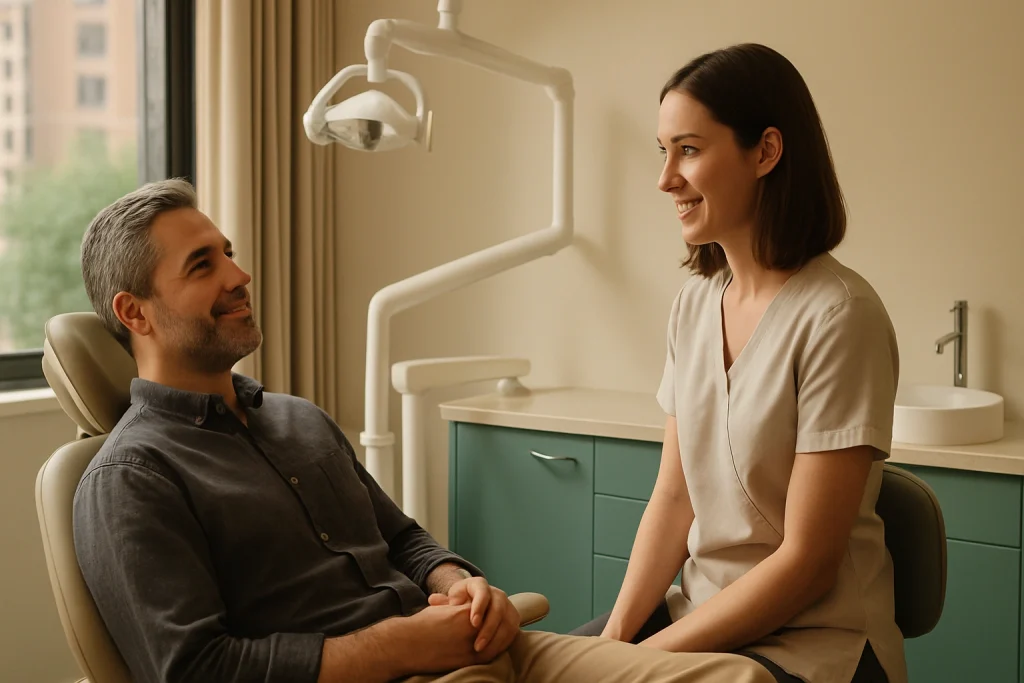
There is a particular kind of appointment that many people carry around for months before they make it. Not a check-up they have simply put off, though that happens too. This one involves sitting down with a dentist Melbourne and saying, out loud, that they would like to do something about how their teeth look. It feels different from a routine visit. More exposed, somehow. More personal. And the prospect of being rushed through it — of being given a clinical verdict in twelve minutes and handed a treatment plan that answers questions they had not yet worked out how to ask — is enough to make some people not come in at all.
We have been on Collins Street for over four decades. In that time, we have sat across from a great many people who arrived at that appointment nervous, and not only because of drills or needles. Many were nervous about being judged. Some had been carrying a concern about their teeth for years. A few could not quite name what they wanted — only that they wanted something to feel different. What all of them needed, before any clinical conversation could begin, was time.
That is what unhurried dentistry means to us. Not an abstract principle. A decision about how we practise.
The thing that gets lost when a cosmetic consultation is rushed
Cosmetic dentistry is a category of care where the conversation matters as much as the clinical examination. When someone comes in wondering about teeth whitening, or asking whether their misaligned tooth could be addressed without orthodontics, or exploring what veneers might actually look like on their particular face — they are not presenting with a problem that has one correct answer. They are opening a dialogue about what they want, and more importantly, about what is realistic, appropriate, and right for them specifically.
Rush that conversation, and several things go wrong.
The patient leaves with information but not understanding. They may have heard the name of a procedure and a price, but they have not had the space to consider what is being proposed or whether it reflects what they actually came in for. The dentist, meanwhile, has offered a solution without fully grasping the concern — because the concern was still forming when the appointment ended. Both parties have technically communicated. But the consultation has not done what a consultation is for.
There is something else, too. Cosmetic dentistry occupies an odd psychological space. Many people feel self-conscious raising it at all — as though wanting to feel more confident about their appearance is somehow shallow, or not a legitimate reason to seek care. It is not, of course. How you feel when you smile is connected to how you move through the world. But that self-consciousness means people often test the water cautiously when they first raise cosmetic concerns. They watch for signs of being dismissed, or being upsold to, or being given a plan that feels like it was designed for someone else. When an appointment feels rushed, those signs are easy to mistake for things they are not.
Why pacing a consultation is a clinical skill, not a luxury
There is a tendency to frame unhurried dentistry as a kind of hospitality gesture — a premium service feature, like better coffee in the waiting room. We think of it differently. The quality of information gathered in a consultation directly shapes the quality of the clinical outcome. In cosmetic care especially, where the desired result is inherently individual and cannot be standardised, cutting short the intake process is not an efficiency. It is a clinical risk.
Consider teeth whitening as a relatively simple example. The range of appropriate whitening approaches — and the degree of whitening that will look natural on a given person — depends on factors that only emerge through conversation and observation: the baseline shade and its origin, the presence of existing restorations, the patient’s sensitivity history, their aesthetic preferences, what they have tried before. A clinician who takes fifteen minutes to discuss all of this before recommending anything is not being slow. They are doing the job properly.
For more involved cosmetic work — veneers, composite bonding, or managing a presentation that might involve a combination of approaches — the stakes of a rushed consultation are considerably higher. Decisions made without adequate information, or with goals that were never clearly established, tend to produce outcomes that satisfy no-one. The patient is not happy because the result does not match what they had in mind. The clinician has no record of what the patient actually wanted, because that was never properly established.
Unhurried dentistry does not mean every appointment is long. It means that the pace of each appointment is set by what the patient and the clinician actually need — not by a scheduling assumption made in advance.
What the consultation itself looks like
For cosmetic enquiries at our practice, the consultation begins with listening. This might sound obvious, but it has a specific clinical meaning: we want to understand the concern in the patient’s own words before we offer any framework for thinking about it. “I want my teeth to look better” and “I am self-conscious about this one tooth when I laugh” are different concerns. So are “I’ve always wanted whiter teeth but I’m not sure where to start” and “I had whitening done a few years ago and I didn’t like how it looked.”
Once we understand the concern, we can look. And once we have looked, we can explain what we see — not just in clinical terms, but in ways that are useful to the person in front of us. What would each option actually involve? How many appointments? What would the maintenance look like? What might not be possible, and why? What would we genuinely recommend, and what are the honest trade-offs?
There is a particular kind of clinical conversation that does not get talked about enough: the one where the right recommendation is to do less, or to do nothing yet. Not every cosmetic concern warrants intervention. Sometimes a patient’s concern is better addressed with information — about what their teeth actually look like relative to their expectations, about what the literature says regarding longevity of different options, about what the realistic outcome of a treatment actually is. A clinician who can have that conversation with a patient, openly and without commercial pressure, is doing something important. That takes time. It also requires a particular kind of clinical confidence — one that is not served by rushing.
The specific value of a practice that has been doing this for a long time
There is something that accumulates over forty-plus years on Collins Street that cannot be replicated quickly. Not just technical skill, though that matters enormously. It is pattern recognition — the ability to hear a concern and understand not just what is being said, but what kind of concern it is. Experience tells us which patients are still forming their question and need more space, and which patients arrive knowing exactly what they want and simply need honest information about whether it is achievable. Those two consultations look different, and the pacing of each should reflect that.
Our clinical team is entirely female — something that, for many patients, shapes how comfortable they feel raising personal concerns. Not all patients seek this out, and we care for people across every demographic: men, women, children, families, CBD professionals from across the inner suburbs. But for those who find that a shared experience makes it easier to be candid — particularly around appearance-related concerns that can feel vulnerable to raise — it is worth knowing that every clinician they will see is a woman. Not as a credential. As a simple fact about how this practice works, and why it works the way it does for a great many people.
A note on what natural results actually require
One of the most common things we hear from patients exploring cosmetic options is some version of: “I don’t want it to look obvious.” They want an improvement, not a statement. They want to feel more confident, not to look like a different person. This is a completely reasonable and, we would argue, clinically well-founded goal — and it is one that is much harder to achieve than the alternative.
Natural-looking cosmetic dentistry requires individual assessment. It requires understanding the relationship between a person’s teeth, their lip line, their facial proportions, their skin tone, their age. It requires a clinician who is willing to advocate for restraint even when a patient is enthusiastic about more. And it requires a consultation long enough to establish what “natural” actually means for that particular person — which will be different from everyone else who has ever sat in that chair.
None of that can happen at speed. It requires the kind of appointment where there is genuine room for a patient to say, “Actually, can we go back? I want to make sure I understand that part.”
The appointment that is worth taking your time for
If you have been sitting with a cosmetic concern — something you have been considering raising but have not quite found the right moment — it is worth knowing that there is no version of that conversation that needs to be rushed. Some of the most useful appointments we have are the ones where a patient comes in not entirely sure what they want, and leaves with a clearer picture — not necessarily of a treatment plan, but of the options available and the questions worth thinking about before committing to anything.
Good cosmetic dentistry begins with a good conversation. And a good conversation, by definition, cannot be scheduled to the minute.
We are at Level 6, 15 Collins Street, six days a week. When you are ready to have that conversation, we are here for it.
Frequently asked questions
What does unhurried dentistry mean in practice?
Unhurried dentistry means we take the time to provide thorough, individualised care without feeling rushed. We understand that cosmetic procedures can be daunting, and it’s essential to create an environment where you feel comfortable discussing your needs and concerns. At our practice on Collins Street, we prioritise attentive listening and patient education, allowing you to make informed decisions about your treatment. Instead of quick fixes, we focus on building a trusting relationship where your comfort is paramount.
How can unhurried dentistry help with cosmetic treatments?
Unhurried dentistry enhances your experience with cosmetic treatments by giving you space to ask questions and express concerns. We know that many people feel uncertain when considering options like teeth whitening or veneers. By approaching each consultation at your pace, we ensure you fully understand the processes and outcomes. Our team, based in the heart of Melbourne CBD, is here to guide you thoughtfully through your choices, helping to alleviate any anxiety and allowing for an informed, confident decision.
Can the female clinical team help me feel more comfortable during cosmetic consultations?
Many patients find that a female clinical team can create a more relaxed atmosphere, especially when discussing cosmetic treatments. Our all-female team is experienced and understanding, ensuring you feel heard and respected in a judgement-free setting. We take time to build rapport and address your specific concerns, allowing you to express your desires and fears openly. At our Collins Street practice, we embrace inclusivity and aim to make every patient, regardless of background, feel at ease.
Explore further
Read more about Our Team at Women in Dentistry.





