
There is a particular kind of trust that builds quietly over years. A parent who has brought their child to the same practice since that child had their first wobbly tooth, and who now watches a teenager sit calmly in the chair — that trust was not built on good marketing. It was built on consistency. On things going right, appointment after appointment, in ways that felt unremarkable precisely because they were meant to.
What most families never see is the work that makes that consistency possible.
This is not a criticism — there is no reason patients should need to see it. But we think there is value in explaining it, especially for parents who are weighing up where to take their family and trying to work out what distinguishes one Melbourne CBD practice from another when the websites all say more or less the same things.
The part of infection control that happens before you arrive
Every consultation room at our Collins Street practice is prepared between patients in a way that follows a defined sequence — not because it feels right on the day, but because the sequence is the point.
Surfaces that come into contact with instruments, hands, or the patient are wiped down with hospital-grade disinfectant. Disposable barriers — the plastic sleeves over equipment handles, the paper on the chair headrest — are replaced entirely. Nothing that touched the previous patient remains exposed for the next one. The dental chair itself is adjusted and reclined between patients, not simply because of preference, but because that process is part of the reset protocol.
Instruments are a separate matter. Anything that enters the mouth or contacts tissue goes through a three-stage process: cleaning, packaging, and autoclave sterilisation. The autoclave — essentially a high-pressure steam steriliser — uses validated cycles that are logged and tested regularly, not assumed to be functioning correctly. Biological indicators are used periodically to confirm that sterilisation is actually occurring, not just that the machine is running.
This is, broadly, what the Australian Dental Association and Australian health authorities require. The reason it is worth explaining is that it answers a question many parents wonder about but rarely ask directly: is it actually clean? Yes. In a methodical, documented, audited sense — yes.
Continuing education is not optional, and it does not stop
Dental registration in Australia requires practitioners to complete continuing professional development — ongoing learning that keeps their clinical knowledge current. For our team at Women in Dentistry, this has been a feature of practice life for over forty years on Collins Street, long before it became a formalised requirement.
The topics vary considerably. Some CPD covers clinical technique: advancements in restorative materials, updated protocols for particular procedures, evidence emerging from large-scale trials. Some covers patient communication — how to support anxious patients, how to discuss treatment options with families who have different priorities, how to talk with children at different developmental stages about what is happening in their mouths.
There is also internal calibration. When a clinical team works together regularly, there is an ongoing informal process of case discussion — reviewing what was done, why, and whether a different approach might have served the patient better. This kind of reflective practice does not produce a certificate. It produces clinical judgement that improves gradually, which is the more valuable thing.
For parents, this matters in a specific way: the dentist your child sees is not working from knowledge acquired once and applied indefinitely. The way children’s teeth are managed — how primary teeth are assessed, when intervention is appropriate versus when watchful waiting is the right call, how to handle the transition to permanent teeth — continues to be refined in the evidence base, and practitioners who stay current reflect that in their clinical decisions.
What “treatment planning” actually means for a family
When a new family comes to us, or when an existing patient brings a child for the first time, the first appointment is rarely just about what is in the mouth at that moment. It is about understanding the whole picture.
For children especially, a check-up involves assessing not only the teeth that are present, but the ones that are not yet there — the eruption sequence, the spacing, whether the bite is developing as expected. It involves asking questions about diet, about habits like thumb-sucking or mouth breathing, about whether there is any history of dental anxiety in the family that might shape how future appointments should be handled.
That last one is more significant than it might seem. Dental anxiety has a documented tendency to pass between generations, often through no one’s fault — a parent who tensed up slightly, a word used carelessly, a first experience that was more uncomfortable than expected. When we know that a parent is nervous, we are more deliberate about how we frame appointments for their child. Not because children are fragile, but because a calm first decade of dental experiences is genuinely protective for the lifetime of care that follows.
Treatment planning, in this context, means thinking across time. It means a dentist who is mentally noting that a child will likely need orthodontic assessment in three years, or that a particular tooth is worth monitoring closely, or that a patient’s enamel pattern suggests they might be a grinder — and then acting on that when the time is right, rather than addressing only what is visible today.
The economics of consistent care, honestly considered
One of the more practical things we can say to families considering where to register is this: consistent, preventive-focused care tends to cost less over time than intermittent care punctuated by urgent treatment.
This is not a promise of what any individual’s experience will look like. Every mouth is different, and some problems arise regardless of how diligently a family attends. But the pattern, at a population level and in our own clinical experience, is clear. A child who has regular check-ups, whose early decay is caught and treated conservatively, whose bite is monitored through the growing years, is less likely to arrive at adulthood requiring significant restorative or orthodontic intervention.
The gap payment for a check-up is visible. The cost of the treatment that was avoided is not — it exists as something that simply did not happen. This is genuinely difficult to communicate, and we understand why families sometimes defer appointments when life is expensive and complicated. Melbourne CBD is not an inexpensive place to live, and health fund benefits vary considerably in what they actually cover.
What we can offer is transparency: before any treatment proceeds, we explain what is proposed, why, and what the cost will be. We process health fund claims on the spot through HICAPS, and we will tell you clearly what the gap payment will be before you need to make a decision. There is no obligation to proceed at the same appointment, and we will never make a family feel rushed into a treatment plan they have not had time to consider.
Why the clinical environment itself is part of the standard
Forty years on Collins Street has given us a particular relationship with this precinct. Families who live in Carlton, Fitzroy, or Collingwood and work in the city often find that a CBD practice fits the rhythm of their week better than a local one might. A parent who can combine a school-holiday appointment with other errands in the city, or who can come in on a lunch break without a significant commute, is more likely to actually attend.
That convenience has a clinical consequence. Patients who find it easy to come in regularly, do. And regular attendance — even without conscious intent — gives a clinical team the longitudinal view of a patient’s oral health that makes genuinely good care possible. We know what your child’s teeth looked like at six, and at nine, and at twelve. We remember what was discussed at the last appointment. We are not reassessing from scratch every time.
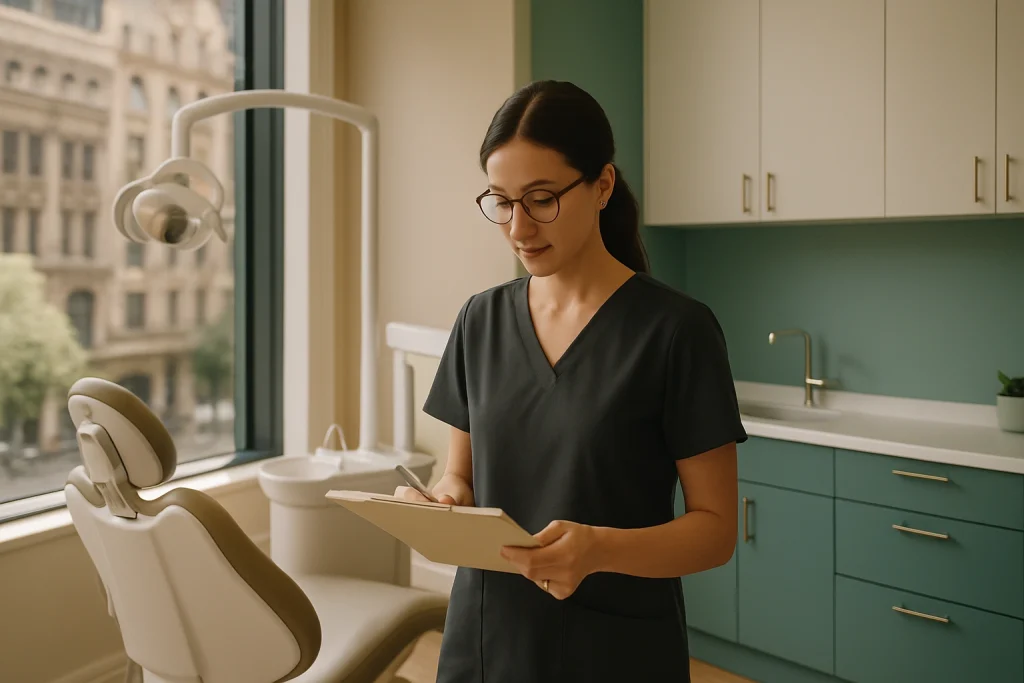
The physical environment matters too, though in a quieter way than practices sometimes claim. Our rooms on the sixth floor look out over the Collins Street corridor — not a selling point, but a real feature of what it feels like to be here. The space is calm, not clinical in the cold sense. For patients who feel some anxiety about dental visits — and this is more common than people tend to admit — the sensory experience of an appointment shapes whether they will come back for the next one.
We think about this consciously. The pace of an appointment, the way questions are asked, how much is explained and how — these are not incidental. They are part of what we consider standard.
A note on choosing, and what to look for
For families actively looking for a dental home in Melbourne — whether you are new to the city, your children are reaching the age where their own care is becoming more complex, or you have simply not found a practice you feel settled at — there are a few things worth considering that are harder to see on a website.
Ask how the practice handles nervous patients, specifically. Not what their general philosophy is, but what they actually do differently. Ask whether the dentist Melbourne will take the time to explain findings before recommending treatment, and whether you can take a day or two to consider. Ask whether your health fund is accepted through HICAPS, and whether they can give you a written estimate before proceeding.
These are reasonable questions, and a practice worth trusting will answer them without hesitation.
The things that are harder to ask about — the sterilisation protocols, the CPD culture, the internal case review — are less visible, but they are the substrate beneath every appointment that feels unremarkable and right. They are what makes the quiet trust possible.
Parents carry a lot of responsibility for their family’s health decisions, and dental care is one of the areas where it is easy to feel uncertain about whether you are doing enough, choosing correctly, or managing the whole thing well. Most of the time, the families we see are doing considerably better than they give themselves credit for.
If you are looking for a practice on Collins Street or in the Melbourne CBD where your family can settle in for the long term, we would be glad to talk about what that looks like.
We are at Level 6, 15 Collins Street — six days a week, and never in a rush.
Frequently asked questions
How does Women in Dentistry ensure high clinical standards?
At Women in Dentistry, we maintain high clinical standards through continuous education and rigorous protocols. Our team participates in regular training and professional development to stay updated on best practices in dentistry. We also adhere to strict infection control measures and conduct regular audits to ensure that our equipment and facilities meet all safety and cleanliness regulations. This consistent effort allows us to provide a safe and comfortable environment for you and your family.
What are the infection control protocols at your clinic?
Infection control is a top priority at Women in Dentistry. We follow comprehensive protocols, including sterilising instruments, using disposable materials where possible, and maintaining a clean and hygienic environment. Our clinical team wears appropriate protective gear to ensure safety for all patients. You can feel assured that we take every necessary step to prevent infection and create a welcoming, safe experience for your family.
What should I consider when choosing a family dentist in Melbourne?
When choosing a family dentist in Melbourne, consider factors such as the practice’s approach to patient comfort, the range of services offered, and the experience of the team. It’s important to find a clinic that values open communication and creates a welcoming atmosphere for all family members — from children to adults. At Women in Dentistry, our entirely female clinical team focuses on providing gentle, thoughtful care while ensuring that every visit is as comfortable as possible.
Explore further
Read more about Our Team at Women in Dentistry.





