
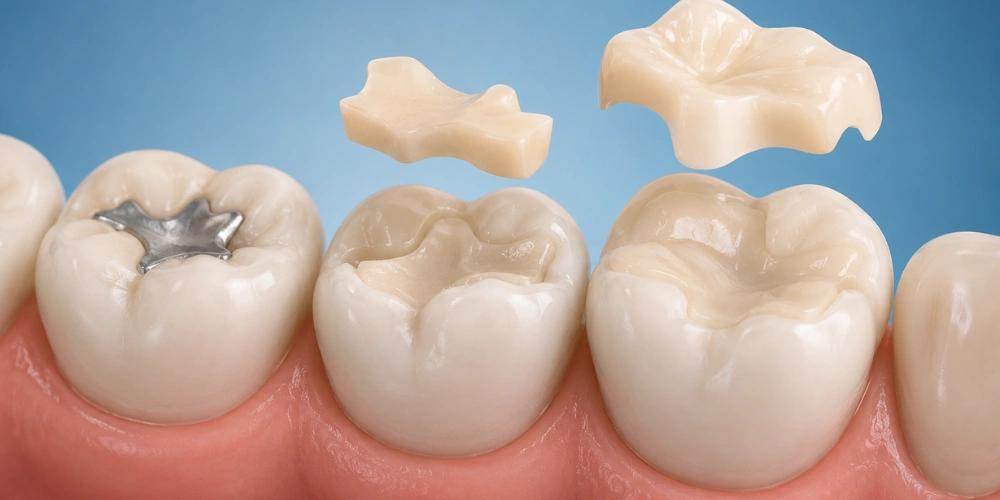
Most people know the two ends of the scale: a small cavity gets a filling, and a badly broken tooth gets a crown. What far fewer realise is that there is a useful middle ground between them, and choosing it well can mean the difference between a tooth that lasts decades and one that fails early. Porcelain inlays and onlays are that middle ground, the considered option when a tooth is too damaged for a simple filling but too sound to justify cutting it down for a crown. Here is what they are, why porcelain is chosen, how the treatment works, and when this restorative option makes sense.
The Gap Between a Filling and a Crown
A standard filling is ideal for small to moderate cavities: the decay is removed and the space is filled and shaped in a single visit. But when a cavity is large, or an old filling has failed and taken more tooth with it, a direct filling can struggle to restore strength, and a big filling in a heavily loaded back tooth is prone to cracking over time.
As healthdirect notes, fillings can chip or crack over time, allowing food and bacteria to become trapped, which is exactly the scenario that escalates a moderate problem into a major one.
The traditional alternative, a crown, solves the strength problem but at a cost: it requires reshaping the whole tooth. Inlays and onlays occupy the sensible space in between, restoring strength while preserving far more of your natural tooth.
What Inlays and Onlays Actually Are
Both are custom-made restorations crafted to fit one specific tooth precisely, then bonded into place. The difference between them is simply how much of the tooth they cover.
An inlay sits within the cusps, the raised points of the tooth, filling the area between them much like a filling but as a single solid, precisely fitted piece. An onlay does more, covering one or more of the cusps themselves, which makes it the choice when a larger portion of the biting surface needs rebuilding.
Because they are made outside the mouth and then fitted, inlays and onlays are known as indirect restorations. That extra step is what allows a level of precision, strength and fit that is difficult to achieve with material shaped directly in the tooth.
Why Porcelain, and Why It Lasts
Porcelain earns its place here for the same reasons it does in other restorations: it is strong, it resists wear, and it can be matched to the natural colour of your tooth so the repair is invisible. For a back tooth that takes heavy chewing forces, that durability matters enormously.
Dentists choose from a range of filling and restoration materials depending on the situation, and for a larger restoration on a working tooth, a bonded porcelain inlay or onlay offers a hard-wearing, tooth-coloured result that a simpler direct filling cannot always match.
There is also a conservation argument, which is really the heart of the case. An onlay can often rebuild a damaged tooth while keeping healthy tooth structure that a crown would have removed, and preserving natural tooth is almost always the better long-term bet.
How the Treatment Works
It begins with assessment. The dentist examines the tooth, often with an x-ray to see the extent of damage inside it, and determines whether a filling, an inlay or onlay, or a crown is the right match for how much sound tooth remains.
If an inlay or onlay is the answer, the tooth is conservatively prepared, old filling material and decay are removed, and precise records are taken from which the restoration is custom-crafted to fit that tooth exactly.
At the fitting stage, the restoration is checked against your bite and then bonded firmly into place. The result restores the tooth’s shape and strength, and with good daily care and regular check-ups, it is built to serve for many years.
Considered Restorative Care in the Melbourne CBD
Choosing between a filling, an inlay or onlay, and a crown is exactly the kind of judgement that rewards an unhurried, experienced approach, and the setting is built for it. The practice has cared for the Melbourne CBD for over 35 years from the Paris End of Collins Street, with an all-female team whose expertise spans restorative and cosmetic dentistry.
Practical details make multi-visit restorative treatment easy for people working in the city: the practice is open six days, and complimentary valet parking removes the usual CBD parking problem entirely.
If you have a large old filling that worries you, or a tooth a dentist has flagged as heavily restored, an assessment is the sensible first step. It can be arranged through the fillings, inlays and onlays service page or the contact page, and it is the difference between planning a tooth’s future and waiting for it to crack.
The Takeaway
Porcelain inlays and onlays are the quiet problem-solvers of restorative dentistry: stronger and longer-lasting than a large direct filling, yet far more conserving of natural tooth than a crown, which makes them the right answer for many moderately damaged back teeth. The key is matching the restoration to how much sound tooth remains, a judgement worth making before a tooth cracks rather than after. Women in Dentistry provides fillings, porcelain inlays and onlays from its Collins Street practice, and a consultation with its all-female team is the unhurried way to find out which option your tooth actually needs.
Frequently Asked Questions
What is the difference between an inlay and an onlay?
Both are custom-made restorations bonded to one tooth; the difference is coverage. An inlay sits within the cusps of the tooth, filling the area between them, while an onlay also covers one or more of the cusps themselves, making it suitable when a larger part of the biting surface needs rebuilding.
When do I need an inlay or onlay instead of a filling?
When a cavity is too large for a simple filling to restore strength reliably, or an old filling has failed and taken more tooth with it, but the tooth is still too sound to justify a full crown. Your dentist Melbourne CBD assesses how much healthy tooth remains to decide which option fits.
Are porcelain inlays and onlays better than a crown?
They are not better in every case, but where they suit, they conserve more natural tooth than a crown, which requires reshaping the whole tooth. For a tooth that needs strength restored but still has sound structure, an onlay can be the more conservative long-term choice. An assessment determines which is appropriate.
How long do inlays and onlays last?
With good daily care and regular check-ups, a bonded porcelain inlay or onlay is built to serve for many years. Porcelain is strong and wear-resistant, which suits the heavy chewing forces on back teeth, and preserving the tooth underneath through good oral hygiene protects the restoration’s lifespan.
Is getting an inlay or onlay painful?
The tooth is prepared under local anaesthetic, so the procedure itself is comfortable, and because preparation is conservative, less tooth is removed than for a crown. Some short-term sensitivity afterwards is normal, and your dentist explains what to expect for your specific tooth beforehand.
This blog is intended for general informational purposes only and does not constitute medical or dental advice. Every patient’s oral health needs are unique. Please consult a qualified dental practitioner for advice specific to your situation. Women in Dentistry encourages all patients to seek a professional assessment before commencing any dental treatment.





