
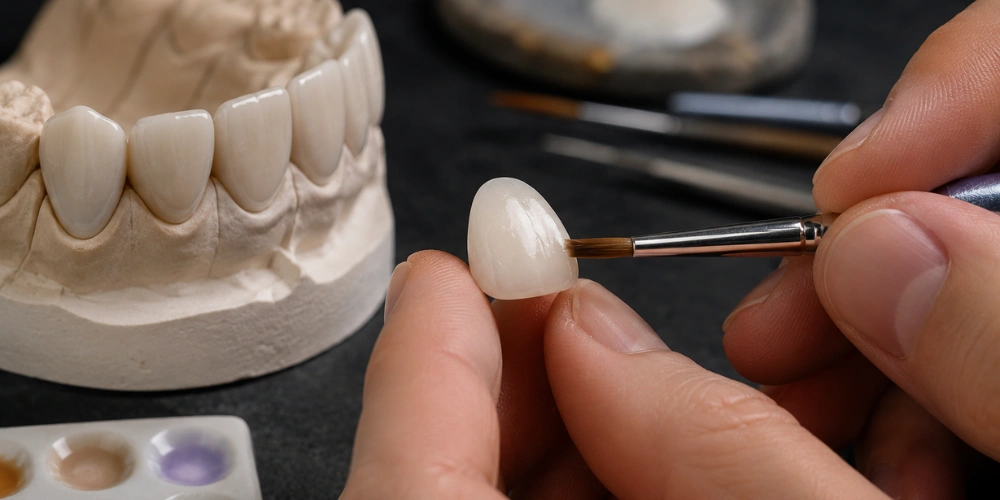
Porcelain veneers have become one of the most requested treatments in cosmetic dentistry, and also one of the most misunderstood. The word veneer covers everything from mass-produced shells to individually handcrafted porcelain, and the difference between those two ends of the spectrum shows up exactly where you would expect: in how natural the result looks on a real face. Handcrafted porcelain veneers are made tooth by tooth, with shape, shade and translucency built for one person’s smile. Here is what veneers actually are, what handcrafting changes, who suits them, and how the process works at a long-established Collins Street practice.
What a Porcelain Veneer Actually Is
A veneer is a thin shell of porcelain bonded to the front surface of a tooth, changing its shape, colour, length or alignment in one move. Veneers are used for chips, wear, discolouration that whitening cannot shift, small gaps, and teeth that have always felt slightly wrong to their owner.
Porcelain earns its place in this job for two reasons: it handles light the way natural enamel does, with depth and translucency rather than flat colour, and it resists staining far better than natural teeth or composite materials.
Veneers sit within the well-established range of cosmetic treatments described in healthdirect’s guide to dental procedures, and as with any treatment, the starting point is an assessment of whether your teeth and goals actually suit them.
Handcrafted Versus Off the Shelf: Why It Shows
Natural teeth are not uniform. They carry subtle variations in shade from gum line to edge, faint surface texture, and tiny asymmetries that the eye reads as real. Veneers produced quickly to a standard template tend to erase all of that, which is precisely what creates the flat, too-perfect look people fear.
Handcrafted porcelain veneers take the opposite approach: each veneer is individually designed and crafted, with layered porcelain building up the depth, character and translucency of natural enamel, and the whole set composed to suit your face, lips and smile line rather than a catalogue ideal.
Shade work is where the craft is most visible. A natural-looking veneer is matched not just to neighbouring teeth but to the person: skin tone, the whites of the eyes, even how the smile reads in daylight versus indoor light. Brilliant white suits some faces and overwhelms others, and a handcrafted approach makes that a design decision rather than an accident.
The result is the quiet kind of cosmetic dentistry, where people notice that you look well rather than noticing that you had work done, and that distinction is almost entirely a function of craft.
Who Veneers Suit, and Who They Don’t
Good candidates typically have healthy teeth and gums with concerns that are cosmetic or structural at the surface: wear, chips, stubborn discolouration, minor crowding or gaps. Veneers solve appearance problems; they are not a substitute for treating decay or gum disease, which always comes first.
Some situations point elsewhere. Heavy grinding can put porcelain at risk and may need managing before veneers are sensible, significant misalignment is often better served by orthodontic treatment, and a single discoloured tooth sometimes needs a different solution entirely.
That sorting is the job of the consultation, and an honest practice treats no as a perfectly good answer. The aim is the right treatment for your mouth, not the most elaborate one.
The Process: From Smile Analysis to Final Bond
Veneer treatment is a staged, deliberate process. It begins with examination and smile analysis, looking at your facial proportions, lip movement and what you actually want changed, followed by planning of the shape and shade each veneer will carry.
The teeth are then carefully prepared, typically with conservative reshaping of the front surface, and detailed records are taken from which the veneers are crafted. At the fitting stage, each veneer is checked against the plan and your smile before being permanently bonded.
Aftercare is reassuringly ordinary: veneers are brushed and flossed like natural teeth, protected from obvious enemies like nail biting and ice crunching, and checked at regular reviews so small issues stay small. Where night-time grinding is part of the picture, a protective splint guards the investment while you sleep.
Done well, the sequence matters as much as the materials, because veneers are a long-term commitment: with sound preparation, quality porcelain and good daily care, they are built to serve for many years.
Craftsmanship With a Collins Street Address
The setting suits the philosophy. The practice has been part of the Melbourne CBD for over 35 years, located at the Paris End of Collins Street, with an all-female team of experienced dentists whose expertise spans cosmetic, restorative and preventative care.
Practical details make the multi-visit veneer process easy for city workers and visitors alike: the practice is open six days, and complimentary valet parking takes the usual CBD parking battle off the table entirely.
A consultation is the natural first step, and an unhurried one, with the team’s philosophy built on education and informed decisions rather than pressure. Appointments can be arranged through the contact page or by phone.
The Takeaway
Porcelain veneers can transform a smile, but the difference between a result that looks made and one that looks born comes down to craft: individually designed, layered porcelain composed for your face rather than a template. The sensible path runs through an honest assessment of whether veneers suit your teeth at all, then a deliberate, staged process from smile analysis to final bond. Women in Dentistry has provided handcrafted porcelain veneers from its Collins Street practice for over 35 years, and a consultation with its all-female team is the unhurried way to find out what your smile could carry.
Frequently Asked Questions
What are handcrafted porcelain veneers?
They are veneers individually designed and crafted for each tooth, with porcelain layered to recreate the depth, translucency and subtle character of natural enamel. The set is composed to suit your face and smile line, rather than being produced to a standard template, which is what keeps the result looking natural.
How long do porcelain veneers last?
With sound preparation, quality porcelain and good daily care, veneers are built to serve for many years. Longevity depends on your habits, your bite and regular dental reviews, and protecting veneers from heavy grinding, where present, is part of planning for their long life.
Do veneers damage your natural teeth?
Preparation is typically conservative, involving careful reshaping of the front surface so the veneer sits naturally. It is a considered, permanent change, which is why the consultation stage matters: veneers are only recommended where teeth are healthy and the approach genuinely suits your situation.
Are veneers better than teeth whitening?
They solve different problems. Whitening lightens natural enamel and suits otherwise sound, evenly coloured teeth, while veneers address shape, chips, wear, gaps and discolouration that whitening cannot shift. Some treatment plans use both, and an assessment determines which your smile actually needs.
Who is not suitable for porcelain veneers?
Active decay or gum disease must be treated first, heavy uncontrolled grinding can put porcelain at risk, and significant misalignment is often better addressed with orthodontics. A thorough consultation sorts this honestly, and sometimes the right answer is a different treatment, or none at all.
This blog is intended for general informational purposes only and does not constitute medical or dental advice. Every patient’s oral health needs are unique. Please consult a qualified dental practitioner for advice specific to your situation. Women in Dentistry encourages all patients to seek a professional assessment before commencing any dental treatment.





