
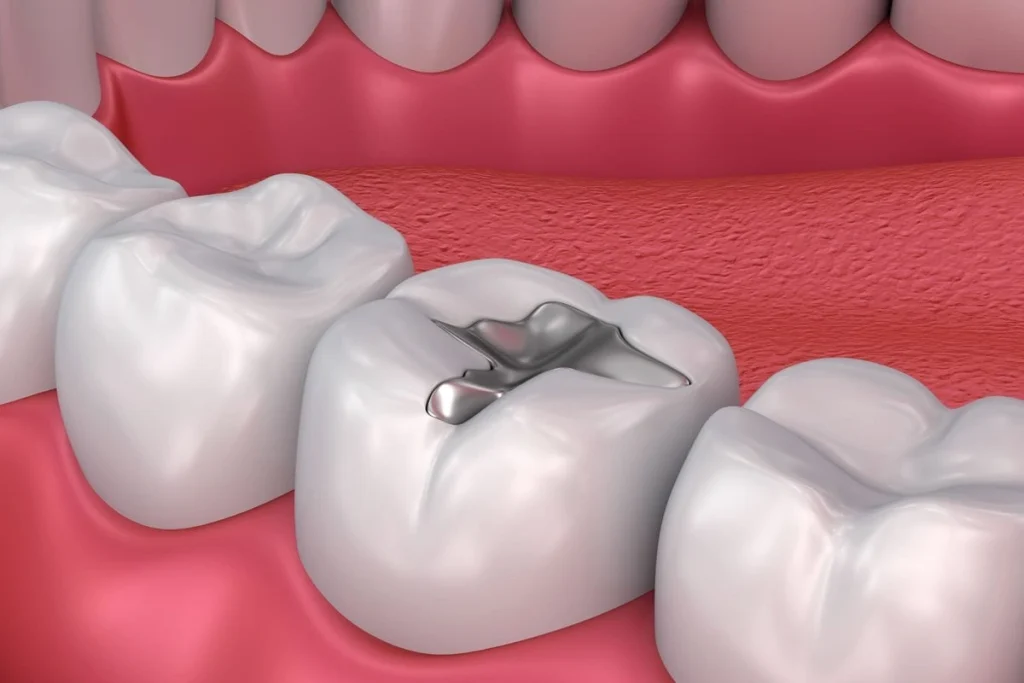
Tooth-coloured fillings, often referred to as composite resin restorations or white fillings, represent a significant advance in cosmetic restorations, unlike traditional amalgam, which comprises mercury and metal alloys. Composite resin materials bond directly to tooth enamel and dentine. This adhesive dentistry approach enables minimally invasive dentistry, preserving more of the natural tooth structure while delivering an aesthetic dental filling that blends seamlessly with adjacent teeth.
Most patients appreciate that these restorations are mercury-free and biocompatible, eliminating concerns over elemental mercury exposure. Their radiopacity ensures they remain visible on radiographs for straightforward monitoring, and their handling characteristics—working time, viscosity, and sculptability—allow the clinician to achieve a highly polished, translucent finish that mimics natural enamel.
How Is the Tooth-Coloured Filling Procedure Performed?
The placement of a composite resin filling involves several precisely executed steps:
- Isolation and Preparation
- Maintain strict moisture control with a rubber dam or cotton rolls
- Remove carious tissue conservatively, avoiding unnecessary removal of healthy enamel
- Etching and Bonding
- Apply an acid-etch to enamel and dentine to create microporosities
- Use a universal adhesive system that penetrates and seals the etched surface
- Incremental Layering
- Place composite in incremental layers to reduce polymerisation shrinkage
- Utilise bulk-fill composite materials for deeper cavities where suitable
- Light-Curing
- Each layer is light-cured according to the manufacturer’s guidelines
- Dual-cure composite systems may be used where extra depth is required
- Finishing and Polishing
- Sculpt and contour to recreate natural tooth anatomy
- Polish to a high gloss, enhancing translucency and stain resistance
By following this technique-sensitive placement, clinicians achieve durable, bioactive restorative materials that release fluoride and resist microleakage.
When Are Tooth-Coloured Fillings Indicated?
Composite resin restorations serve a wide range of clinical scenarios. Common indications include:
- Class I and II Cavities
- Small to medium-sized occlusal and interproximal restorations
- Anterior Restorations
- Class III and IV cavities where aesthetics are paramount
- Class V Lesions
- Cervical defects requiring a conservative build-up
- Enamel Repairs
- Chipped or fractured enamel restoration
- Replacement of Amalgam
- Removal of discoloured or failed fillings in favour of cosmetic restorations
- Fissure Sealants
- Preventive application to developmental grooves
These resin-based composites can be used in both anterior and posterior teeth, providing patients with a uniform smile and strengthening the remaining tooth structure.
What Are the Key Advantages of Tooth-Coloured Fillings?
Tooth-coloured fillings offer several benefits over amalgam restorations:
- Seamless integration with natural tooth enamel
- Strengthens the remaining tooth via adhesive bonding
- Conservative preparation preserves more healthy tooth tissue
- Mercury-free formulation reduces patient concerns
- Chairside repairability if minor chipping or wear occurs
By choosing composite resin restorations, patients enjoy a durable, aesthetic result that supports long-term oral health without the drawbacks associated with metal fillings.
What Potential Limitations Should Be Considered?
While composite materials continue to evolve, practitioners and patients should remain aware of certain limitations:
- Technique-sensitive placement requiring meticulous moisture control
- Risk of polymerisation shrinkage if layering protocols are not strictly followed
- Potential for marginal staining over time in high-stain environments
- Slightly lower wear resistance in extremely high-stress occlusal areas
Nevertheless, modern nanohybrid composites and bioactive restorative materials have significantly reduced these issues, offering longevity that rivals that of amalgam in many cases.
How Do Tooth-Coloured Fillings Compare to Amalgam?
| Feature | Tooth-Coloured Fillings | Dental Amalgam |
| Material Composition | Composite resin (methacrylate-based) | Alloy of mercury, silver, tin |
| Aesthetic Outcome | Matches natural tooth colour | Metallic, visible in mouth |
| Tooth Preparation | Minimally invasive | Requires undercuts for retention |
| Adhesion | Adhesive bond to enamel/dentine | Mechanical retention only |
| Biocompatibility | Mercury-free, low allergenic potential | Contains mercury, potential concerns |
| Longevity | 5–10 years (depending on location and technique) | 10–15 years or more |
| Thermal Conductivity | Similar to natural tooth | Higher conductivity; temperature sensitivity |
| Radiographic Detection | Radiopaque (visible) | Highly radiopaque |
| Repairability | Can be repaired/patched easily | Typically replaced if failed |
| Cost | Generally higher per restoration | Lower material cost |
This table highlights the clear advantages of tooth-coloured fillings in terms of aesthetics, conservation of tooth structure and biocompatibility.
Why Should You Choose Women in Dentistry for Your Tooth-Coloured Fillings?
At Women in Dentistry, our dentists specialise in the latest adhesive dentistry techniques and utilise only the highest standard resin-based composites. We are committed to minimally invasive dentistry, ensuring each restoration conserves as much natural enamel as possible. Our practice:
- Emphasises precise shade-matching using advanced digital shade-selection tools
- Employs universal adhesive systems for optimal bond strength
- Offers bulk-fill composite options for efficient yet thorough treatment
- Provides bioactive composites that release fluoride and support oral health
Our patient-centred approach guarantees a comfortable experience, with detailed explanations at every stage and aftercare advice to maintain your restorations for years to come.
References
- Australian Dental Association. Fluoride Toothpastes Fact Sheet (March 2016).
- Australasian Academy of Paediatric Dentistry. Call for new fluoride toothpaste guidelines as dental crisis soars (Courier Mail, February 2025).
- Australian Dental Association. Policy Statement 2.2.1 – Fluoride Use.
Frequently Asked Questions
- What exactly is polymerisation shrinkage, and why does it matter?
Polymerisation shrinkage occurs when the composite resin contracts slightly during light-curing. If not managed with incremental layering techniques, this can lead to marginal gaps and microleakage, potentially causing sensitivity or secondary decay. - Are tooth-coloured fillings suitable for large cavities?
While ideal for small to medium restorations, large cavities under heavy occlusal loads may be better served by indirect restorations such as inlays or onlays. However, bulk-fill composites can sometimes extend indications. - How long can I expect a composite filling to last?
With proper technique and maintenance, most tooth-coloured fillings last between 5 and 10 years. Factors such as bite forces, oral hygiene and dietary habits will influence longevity. - Will I experience sensitivity after placement?
Some temporary sensitivity to hot or cold is normal for a few days following placement. Persistent or severe sensitivity should be evaluated, as it may indicate bonding issues or pulp inflammation. - Can existing amalgam fillings be replaced with composites?
Yes. Many patients choose to remove discoloured or failing amalgam fillings in favour of aesthetic composite restorations. The procedure involves careful removal and stepwise bonding as per composite protocols. - How do I care for my tooth-coloured fillings at home?
Maintain excellent oral hygiene with twice-daily brushing using a fluoride toothpaste, daily interdental cleaning, and regular dental check-ups. Avoid excessive consumption of staining foods and beverages to preserve the composite’s polish.





