
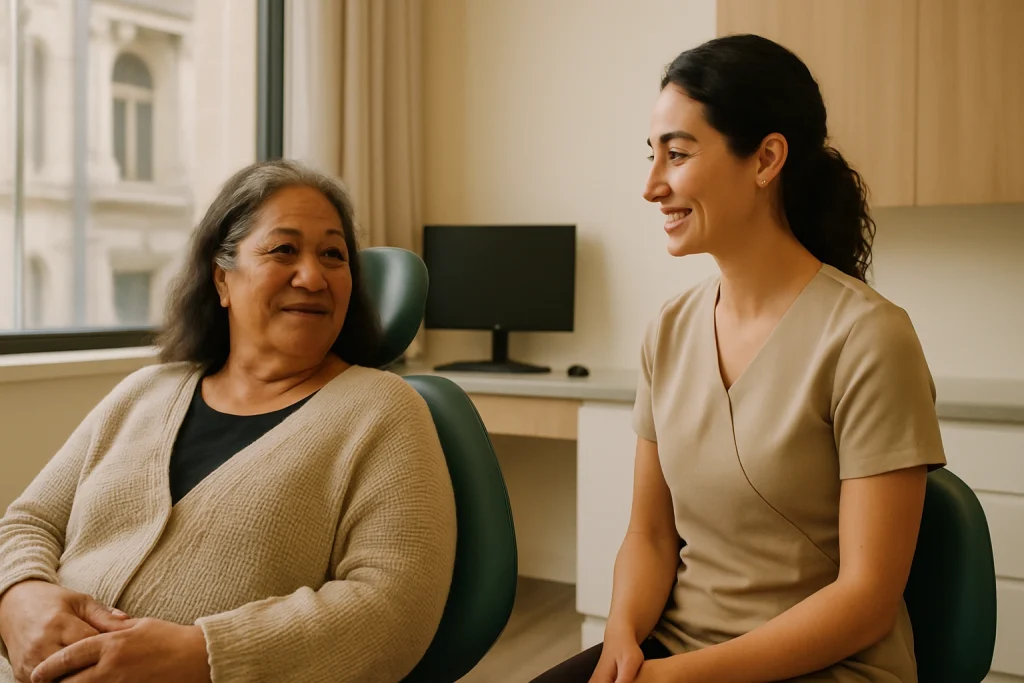
The gap is rarely something that happens all at once. It starts with a busy patch — a move, a new job, a difficult year. Then a little time passes and the whole idea of going back starts to feel complicated in a way that is hard to explain. The longer the gap, the heavier it gets. Eventually some people tell us they have not seen a dentist in five years, or ten, and they say it the way you might confess something. Quietly. Braced.
We want to say something clearly, at the outset: there is nothing to confess.
We have worked on Collins Street for over four decades. We have seen every possible version of this situation — people who came back after two years, people who came back after twenty, people who were avoiding care they genuinely needed and were frightened of what we would find. What we know from all of that experience is this: the decision to come back is the only thing that matters. Everything else is just dentistry. And dentistry, at its most honest, is just problem-solving — careful, unhurried, collaborative.
Why the gap happens — and why it makes complete sense
People do not usually avoid the dentist because they are careless. They avoid it because something made them afraid. Sometimes that fear traces back to a specific experience — an appointment that was rough, a practitioner who felt dismissive, a moment where they felt they had no control over what was happening. Sometimes it is more diffuse than that: a general dread with no clear origin, which is actually extremely common and genuinely not something to push through alone.
Cost plays a role too. So does the feeling that your teeth are in a state you would rather not have confirmed. There is a particular psychology to this — the idea that not knowing is somehow preferable to knowing — that we understand completely, even as we gently note that things left unaddressed rarely simplify themselves.
And then there is shame. This one matters, because it is often the thing that keeps people from picking up the phone even after they have decided they want to come back. Many patients tell us they were embarrassed before they arrived, and then, almost without exception, they tell us afterwards that the embarrassment disappeared the moment they sat down. That gap between anticipation and experience is one of the most consistent things we observe. The story people have built up in their minds about how they will be received is almost never the reality.
What we actually do at a first appointment after a long absence
An appointment after a significant gap is not the same as a routine check-up, and we do not treat it as one.
We begin with a conversation. Not a form, not a quick scan — a real conversation about where you are at, what brought you in, what you are hoping to understand, and what, if anything, you are worried about. If you have had a difficult experience with dental care in the past, this is genuinely useful information for us. It changes how we approach the appointment. It tells us where to go slowly, what to explain more carefully, when to pause.
The clinical examination itself is thorough but gentle. We look at the teeth and gums, assess the condition of any existing restorations, check the soft tissues, and where appropriate, take X-rays to see what is happening beneath the surface. None of this is designed to build a case against you. It is designed to give us an accurate picture so that we can, together, work out what actually needs attention.
What we do not do is present a long list of problems and a treatment plan on the same day. That can feel overwhelming, and it is rarely how good clinical decision-making works anyway. If there is something that needs to be addressed promptly — active infection, something that is causing or will soon cause discomfort — we will tell you that clearly. But most of the time, what we find is a situation that has room for a thoughtful, staged response. We talk through the options, explain the reasoning, and let you decide how you want to proceed.
The things people worry about most — and what we can honestly say about them
“My teeth are in terrible condition and you’ll be shocked.”
We will not be. Truly. The range of situations we see is genuinely wide, and we are not in the business of performing reactions. What we are in the business of is working out what is going on and what can be done. Even after a long gap, even when there are real issues to address, there is usually a clearer path forward than people fear.
“It’s going to be painful.”
We cannot promise that dentistry is without discomfort — no one should make that promise, and any practitioner who does is not being straight with you. What we can say is that we work carefully, use local anaesthetic whenever it is helpful, and take our cues from you throughout. If you need to stop, we stop. If you need more time before we continue, we take it.
“You’ll judge me for not coming sooner.”
This one we can answer simply and without qualification: no. We know that life is complicated, that fear is real, and that dental care sits at the intersection of health, cost, self-consciousness, and time in a way that makes avoidance understandable. Judgement is not part of how we work. It never has been.
The longer gap and what it means clinically
There is a clinical reality worth acknowledging honestly here, because we think patients deserve honest information rather than reassurance that glosses over it.
A longer gap does sometimes mean there is more to address. Gum disease, in particular, can progress quietly — without significant pain — over years. Decay that might have been caught early can progress to a point where more involved treatment is needed. These are not things we say to frighten anyone into coming back sooner. They are simply true, and knowing them can help frame why returning, even now, matters.
What is also true: almost everything we find at a first appointment after a long absence is manageable. Dentistry has developed considerably in terms of what it can address and how it does so. A situation that feels, from the inside, like an irreparable mess is very rarely that. What it usually is, is a situation with a clear set of steps — some more pressing than others, some that can wait — and a practice that can help you work through them at a pace that suits you.
Gum health, particularly, responds well to care. If there has been some disease progression in the periodontal tissues — which is common in people who have not had professional hygiene care for a period of years — a course of thorough treatment can often restore a significant degree of health. This is one of the genuinely encouraging things about returning: the mouth has a meaningful capacity to recover when given appropriate attention.
Being nervous is not a problem you need to solve before you arrive
A lot of people think they need to manage their anxiety before they can come in — that they need to reach some threshold of composure before they will be ready. This is not how it works, and we would gently push back on that idea.
You do not need to arrive calm. You can arrive nervous, uncertain, a little resistant, quietly hoping we will not find anything. You can tell us all of this. In fact, it helps us if you do, because then we know where you are and can respond to you as a person rather than as a set of teeth.
If it helps to bring someone with you — a partner, a friend, anyone whose presence makes things easier — please do. We are entirely comfortable with that arrangement and have no interest in making you navigate the experience alone if company helps.
Some patients find it useful to speak with us before their appointment, just to talk through their concerns without being in the chair. We can accommodate that too. The goal is simply to make the first step as small as possible, because the first step is almost always the hardest.
Collins Street — and what forty years in the same place means for a patient like you
There is something worth noting about longevity in practice. When a clinic has been in one location, serving one community, for over four decades — as we have, at Level 6 on Collins Street — it accumulates something that is difficult to manufacture: a deep, genuine familiarity with the experience of returning patients.
We have seen, over the years, patients who came back after difficult periods in their lives and rebuilt their relationship with dental care incrementally, one appointment at a time. We have seen patients who arrived certain that their situation was beyond help, and who discovered — with time and good clinical work — that it was not. We have seen the relief that comes when someone finally feels safe enough to sit in the chair and be honest about how long it has been and how worried they are.
These are not dramatic stories. They are quiet ones. But they are also the reason why the question of judgement — of whether you will be received with warmth or made to feel small for having been away — is one we take seriously. Our clinical team is entirely female, and the practice culture we have built over a long time in Melbourne CBD is one that places considerable weight on the emotional dimension of care, not just the clinical one. That is not a marketing position. It is simply how we work.
One last thing
The decision to come back — whenever it happens, after however long — is the beginning of something, not the end of something. The past is not what we are interested in. What we are interested in is where you are now, what you need, and how we can help you get there as comfortably as possible.
If it feels like the right time, we are at Level 6, 15 Collins Street, six days a week, and we are glad you found your way here.
Frequently asked questions
What will happen during my first appointment after not seeing a dentist for years?
At your first appointment, we will take time to understand your dental history and any concerns you may have. It can feel a bit daunting after a long gap, but we’ll conduct a gentle examination and talk through our findings together — no rushing. Many people share similar feelings, and our team is here to support you in a calm and respectful environment. We’ll make sure you feel comfortable asking questions and discussing your needs at every step.
Will I be judged for not visiting the dentist in a long time?
No — we understand that it’s common to delay dental visits for various reasons, and our practice is a judgement-free zone. You are not alone in feeling this way, and we genuinely want to help you feel at ease. Our team prioritises gentle, compassionate care and is committed to working with you at a pace that feels comfortable for you, ensuring you receive the support you need as you return to dental health.
How can I manage my anxiety before coming in for a dental appointment?
It’s completely normal to feel anxious before a dental visit, especially if you’ve had bad experiences in the past. One effective way to manage your anxiety is to communicate openly with us before your appointment. Letting our team know how you feel allows us to tailor the experience to your needs. Whether you prefer a few moments to breathe before your appointment or would like reassurance throughout, we are here to support you in any way that helps ease your nerves.





