
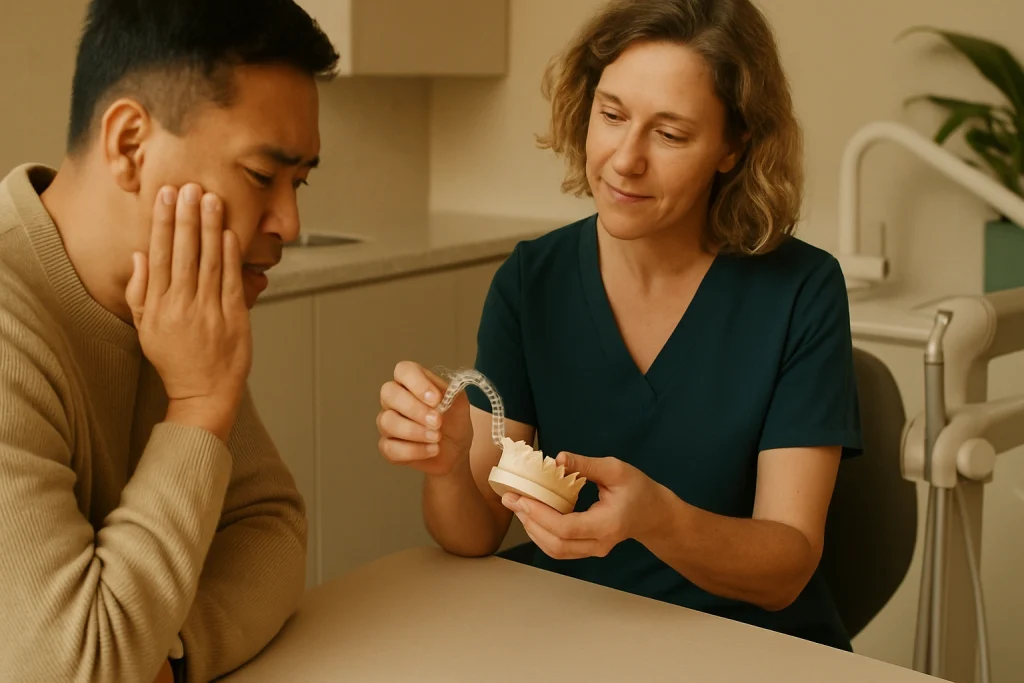
Most people who grind their teeth at night have no idea they’re doing it. The jaw works through the night — rhythmically, forcefully, completely below the threshold of consciousness — and the first real evidence tends to surface somewhere unexpected. A dull headache that’s always there by mid-morning. A sensitivity to cold that wasn’t there six months ago. Or, for some, a comment from a dentist during a routine check-up: your enamel is wearing in a pattern that suggests bruxism.
That conversation tends to stop people. Because enamel, once worn, does not come back.
The forces involved are not subtle
There is a useful number here, and it is worth sitting with for a moment. During normal eating, the teeth come together with a force of roughly 70 to 150 newtons. During bruxism — active nocturnal grinding — that figure can exceed 900 newtons. This isn’t a curiosity. It explains why even occasional grinding, sustained over months or years, can produce the kind of structural damage that dentists see on the flat, glassy surfaces of worn posterior teeth, or the chipped edges of front teeth that their owners have attributed to everything but the real cause.
The mechanism matters because understanding it changes how you think about the urgency. This is not a cosmetic inconvenience. The enamel on your teeth is the hardest tissue in the human body, and it is being ground away, night after night, by a force that no filling material, veneer, or orthodontic appliance was designed to withstand indefinitely.
Why people grind — and why it is rarely just one thing
Bruxism has been studied for decades, and the honest answer is that its causes are plural and interacting. Stress and anxiety are consistently implicated — the jaw, for many people, becomes a site of physical tension in the same way that shoulders tighten or sleep becomes restless during difficult periods. This is not a psychological weakness; it is physiology. The muscles of mastication — the masseter, temporalis, medial pterygoid — are responsive to the same autonomic pathways that govern the stress response, and they respond accordingly.
But stress alone rarely tells the whole story. Occlusal factors matter too: the way your teeth meet when your jaw closes, whether there are interferences in that contact that prompt the jaw to search for a more comfortable resting position. Sleep-disordered breathing — including obstructive sleep apnoea — is now understood to have a meaningful relationship with bruxism, which is one reason that anyone presenting with significant grinding should be asked about the quality of their sleep, not just the stress in their life. Certain medications, particularly SSRIs, are associated with increased bruxism activity. Caffeine and alcohol, particularly in the evening, can intensify it.
This is the kind of complexity that a thorough assessment is designed to untangle. Coming in with jaw pain or worn enamel is not a simple errand — it opens a conversation that often reveals more than the presenting symptom.
The signs that are easy to attribute to something else
One reason bruxism goes undetected for so long is that its early signs are plausible-seeming symptoms of other things. Sensitivity that develops along the gumline might read as the result of aggressive brushing. Morning headaches — particularly at the temples or behind the eyes — get attributed to poor sleep or dehydration. Jaw fatigue or a mild aching in the face on waking can feel like simply sleeping awkwardly. Even a partner’s observation of grinding sounds in the night is often dismissed as occasional and therefore unremarkable.
The clinical signs are more reliable. Flattened or shortened teeth — where the biting edges have lost their natural topography — are characteristic. Micro-fractures in enamel. Indentations along the lateral border of the tongue, or scalloping of the inner cheeks, which suggest clenching even in the absence of active grinding. Hypertrophy of the masseter — a broadening or squareness of the jaw — in people who have clenched for years. In some cases, dentine exposure along the biting surfaces, visible as a yellower, slightly softer-looking centre within the enamel.
None of these develop overnight. Most people who present with moderate to advanced bruxism will recognise, in retrospect, that the signs were there earlier than they registered.
What this means specifically for Invisalign patients
This is where the clinical conversation becomes particularly relevant — and where we want to be genuinely honest with the people considering or currently undergoing Invisalign treatment at our Collins Street practice.
Aligners are precision instruments. They are fabricated to a very specific set of tooth positions, and they work by applying controlled, graduated pressure over time. Bruxism introduces a variable that wasn’t factored into that calculation. The forces generated during nocturnal grinding can distort aligners — warping them in ways that are subtle but clinically meaningful, so that the pressure being applied no longer corresponds to the treatment plan. In cases of significant bruxism, aligners can crack. More commonly, they simply wear faster than they should, and the result is a fit that becomes less predictable as treatment progresses.
There is also the matter of what bruxism is doing to the teeth themselves during treatment. Invisalign moves teeth through bone — a slow, carefully managed process that depends on the periodontium and supporting structures being in a stable state. Excessive occlusal forces work against that stability. Tooth mobility, which can occur as teeth are moving, may be exacerbated by ongoing grinding. And if enamel continues to wear during treatment, the final result will rest on a structural foundation that is already compromised.
None of this means that Invisalign is not possible for people who grind. It means it needs to be managed thoughtfully, with the bruxism treated as part of the overall case rather than a separate concern to address later.
Managing bruxism alongside orthodontic treatment
The most established management approach is an occlusal splint — sometimes called a night guard or bite plate — worn during sleep. A well-fitted splint creates a hard acrylic surface that absorbs and distributes the forces of grinding, protecting both the natural teeth and, in the context of Invisalign treatment, preserving the integrity of the aligners as much as possible.
The relationship between a splint and Invisalign aligners requires some thought. In some cases, the aligner itself can serve a protective function during the treatment period, though it was not designed for this purpose and its wear may be accelerated. In others, a separate splint is fabricated for use when the aligners come out. How this is managed depends on the individual case — the severity of bruxism, where in the treatment the patient is, and the clinical judgement of the treating practitioner.
Beyond the splint, there are other avenues worth considering. Physiotherapy targeting the jaw musculature can provide meaningful relief, particularly for people whose bruxism is accompanied by significant pain or limited opening. For some patients, the relationship between stress and bruxism is direct enough that strategies addressing sleep hygiene and tension management make a noticeable difference. In certain cases, botulinum toxin injections into the masseter muscle are used to reduce the force of clenching — this is a medical application with a reasonable evidence base for symptom relief, administered by appropriately qualified practitioners.
We would be cautious about framing any of these as definitive solutions. Bruxism, particularly sleep bruxism, is often a long-term condition that is managed rather than resolved. The goal is protection and stability — keeping the teeth and supporting structures in as good a condition as possible over time.
The cost of leaving it unaddressed
This is the part that patients sometimes need to hear plainly, and we prefer to be straightforward about it. The downstream costs of untreated bruxism — in terms of restorative dentistry — are significant. Worn teeth eventually need to be built back up, which may involve bonding, crowns, or more extensive rehabilitation depending on the degree of loss. Cracked teeth may become symptomatic, requiring root canal treatment or extraction. Temporomandibular joint dysfunction, which can develop over years of excessive loading, has its own treatment considerations and can be genuinely difficult to manage once established.
For someone partway through Invisalign treatment, adding the complexity of worn or fractured teeth to an already active case increases treatment time, cost, and uncertainty. Managing bruxism now — even imperfectly, even incrementally — is reliably less expensive than managing its consequences later. This is not meant to alarm. It is meant to be the kind of honest information that helps people make considered decisions about their oral health.
What a thorough assessment actually involves
If bruxism is suspected — either because a patient has noticed the signs themselves or because something has come up in a routine check-up — the assessment is more than a visual inspection of the teeth. It involves a detailed occlusal evaluation: how the teeth contact in maximum intercuspation, whether there are any premature contacts or interferences, how the jaw moves through its range of motion. It involves examining the temporomandibular joints for tenderness, clicking, or restriction. It involves looking at the muscles of mastication for signs of hyperactivity or hypertrophy.
In some cases, where sleep-disordered breathing is a possible contributing factor, the assessment may prompt a referral for a sleep study. This is not an overreaction — it is appropriate clinical thinking, and it reflects the reality that the mouth does not operate in isolation from the rest of the body.
At our Collins Street practice, these conversations tend to take time. Not because bruxism is mysterious, but because the relevant factors are individual, and the management needs to reflect that. There is no standard protocol that applies uniformly to everyone who grinds their teeth. There is, instead, a careful look at what is actually happening — and a plan that is honest about what it can and cannot achieve.
A quiet word to anyone who has been putting this off
It is entirely understandable to notice a symptom — a jaw that aches, a tooth that has become sensitive — and to file it away for later. People are busy, dental visits are not always comfortable to contemplate, and there is often a background hope that the thing will resolve on its own. Sometimes it does. But enamel that has worn away will not regenerate, and a pattern of grinding that continues without any management will not become less damaging over time.
If you have been aware of something — morning headaches, jaw tension, a comment from a previous Melbourne dentist that you did not quite follow up on — coming in for a thorough assessment is a reasonable next step. Not urgent in the way that tooth pain is urgent, but meaningful. The kind of thing that, done now, may prevent a considerably more complex conversation a few years from now.
We have been on Collins Street for over forty years. We have seen what protective, consistent dental care does for people over the long term. We have also seen what happens when the early signs are left unattended. Neither observation is intended as pressure — only as perspective from a team that has had these conversations with patients many, many times.
If it feels like the right time to come in, we are at Level 6, 15 Collins Street, and we are available six days a week.
Frequently asked questions
What are the signs of teeth grinding (bruxism)?
Signs of teeth grinding can include worn-down enamel, increased tooth sensitivity, and even jaw pain. You may also notice yourself clenching your jaw or experiencing headaches upon waking. If you believe you might be grinding your teeth, we encourage you to visit us at our Collins Street practice for a thorough assessment. Understanding what’s happening can help us work together on a suitable solution. It’s common to overlook these signs, but rest assured, you’re not alone.
What causes teeth grinding, and how can it affect my Invisalign treatment?
Teeth grinding, also known as bruxism, can be caused by several factors, including stress, anxiety, misaligned teeth, or even sleep disorders. If you’re using Invisalign, it’s important to address bruxism, as it can affect how well your aligners fit and your overall progress. We’re here to support you in managing this concern, discussing tailored strategies to help you maintain both your oral health and the effectiveness of your treatment during your visits to our Melbourne CBD practice.
How long does Invisalign take for adults in Melbourne?
The duration of Invisalign treatment can vary from person to person, typically lasting anywhere from 6 to 18 months. Factors influencing the timeframe include the complexity of your case and how consistently you wear your aligners. During your initial consultation at our Collins Street clinic, we can provide a more personalised estimate based on your specific needs and goals. Remember, every step of your journey is important, and we’re here to support you along the way.
Explore further
Read more about Teeth Grinding and Jaw Problems at Women in Dentistry.





