
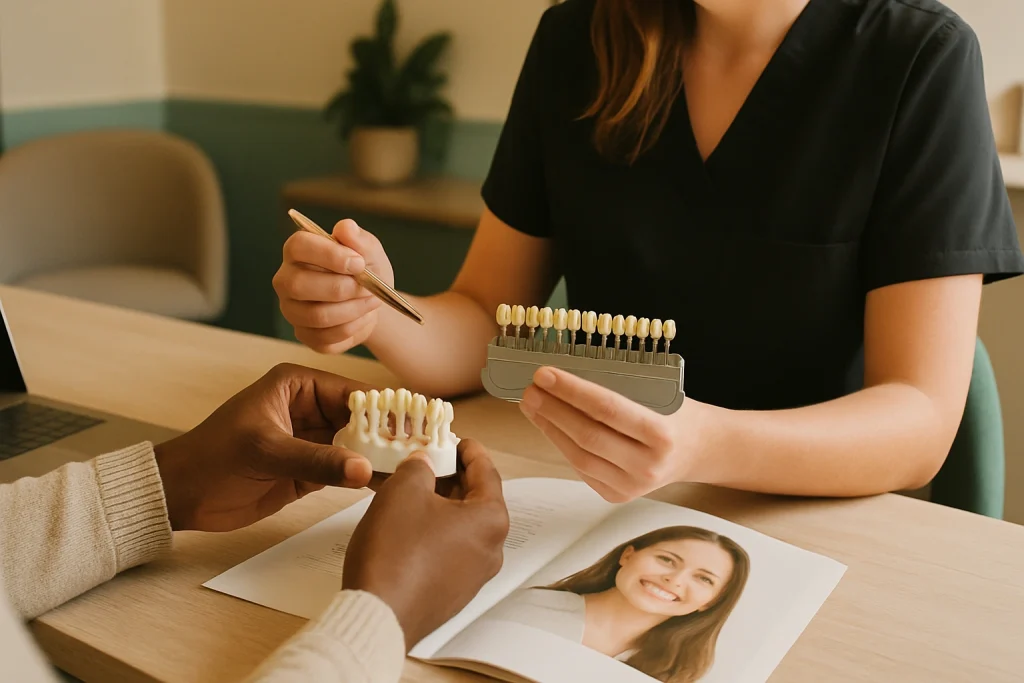
Most people arrive at a veneer consultation already certain they want them. They have spent months — sometimes years — thinking about it. They have saved reference photos. They know the terminology. And they have often already rehearsed the conversation in their head, the one where they describe what they want and the dentist tells them it can be done.
What surprises many patients is that the most useful consultation is not the one that confirms their plan. It is the one that tests it — carefully, honestly, and without any pressure to arrive at a particular conclusion.
That distinction matters more than it might seem.
The preparation that happens before you walk in
There is a version of preparation that is genuinely useful, and a version that mostly reflects anxiety about being taken seriously. The latter usually involves arriving with an extremely specific reference image and a slight defensiveness about whether the clinician will understand the vision. We recognise this. It is completely understandable, and it is more common than most people realise.
The preparation that actually serves you is quieter and more personal.
Before your consultation, spend some time considering not just the look you want, but why you want it — and what specifically about your current teeth sits uncomfortably with you. Is it the colour? The shape of one or two teeth in particular? The way they look in photographs versus in the mirror? The way they sit when you are relaxed versus when you smile? These are not trivial distinctions. They shape the clinical conversation considerably, and they also help us understand whether veneers are genuinely the right pathway, or whether another option might address the same concern with less intervention.
Reference images are useful, but with one caveat worth understanding: images of other people’s teeth are images of other people’s faces. What reads as natural and proportionate on one set of features can look conspicuous on another. When we look at images together, we are not looking for a template. We are looking for information about what appeals to you — the brightness, the length, the alignment, the overall character — so that we can think about what version of that makes sense given your actual anatomy.
Write down your questions before you come in. Not because you will be hurried, but because it is easy to leave a consultation feeling that you covered everything and then think of the important question in the lift on the way down to Collins Street.
What the clinical side of the consultation actually involves
A thorough veneer consultation is not primarily a conversation about aesthetics. That part matters, but it rests on a clinical foundation that has to come first.
Before any discussion of shapes or shades, we need a clear picture of the current state of your oral health. Veneers applied over untreated decay, periodontal instability, or significant bite issues are veneers that will not last and may create problems that are more complicated to address later. This is not a technicality — it is the central reason why a proper consultation takes the time it does.
We will assess the health and condition of the teeth being considered. We will look at your bite and how your teeth meet, since an unusual bite pattern affects both the design of veneers and their long-term durability. We will ask about habits like grinding or clenching, which many people are not aware they do (often happening at night, often discovered through symptoms rather than memory). If there is evidence of bruxism, that does not necessarily rule out veneers, but it changes the conversation significantly — about material choice, about whether a night guard should be part of the plan, and about realistic expectations for longevity.
We will also take the time to examine the thickness and structure of your existing enamel, because most veneers require some degree of preparation — the removal of a thin layer of tooth surface to make room for the veneer so it sits naturally rather than appearing thick or protruding. How much preparation is appropriate depends on the individual tooth. In some cases, minimal preparation is possible. In others, more is required. This is discussed openly, because it is the kind of irreversible step that deserves to be understood before you proceed.
The question that separates a good consultation from a great one
Here is something worth knowing before you come in: the most clinically sound consultation will, at some point, entertain the possibility that veneers may not be the most appropriate option for you right now — or at all.
That is not a gentle rejection. It is the kind of honest engagement that a considered practitioner owes every patient who is contemplating an elective procedure.
There are situations where teeth whitening, done properly and with appropriate professional support, addresses the core concern without any tooth preparation at all. There are cases where composite bonding — a more reversible, less involved option — can achieve something genuinely close to what the patient wanted from veneers at considerably less commitment. There are patients whose concerns centre on alignment, and for whom clear aligner therapy like Invisalign would address the underlying issue in a way that veneers alone would not.
None of this means veneers are the wrong answer. For many patients, they are exactly the right option — well-suited to the concern, supported by good dental health, and likely to provide results that hold well over time with straightforward care. But the consultation earns its value precisely because it considers the alternatives honestly, rather than confirming whatever the patient walked in wanting to hear.
If you leave a cosmetic consultation feeling that every question you asked was met with immediate agreement, that is worth sitting with for a moment.
Understanding the cost conversation — without the awkwardness
Cost is something many patients feel slightly uncomfortable raising directly, as though asking about fees undermines the clinical seriousness of the consultation. It does not. Fees are part of an honest discussion, and we would rather have the conversation fully than have patients leave with an incomplete picture.
The cost of veneers in Melbourne varies depending on the material chosen — porcelain veneers and composite veneers sit at different price points, reflect different clinical processes, and have different longevity profiles. The number of teeth involved matters. The complexity of any preparatory work matters. Whether restorative treatment needs to be completed before proceeding affects the overall picture.
We explain all of this clearly. Health fund rebates may apply to some components of treatment, and we are happy to work through what HICAPS claims look like for your particular plan. Gap payments vary, and we will give you a written treatment plan with itemised fees so that the financial side is transparent before you make any decisions.
The reason to understand costs at this stage is not to pressure a decision in either direction. It is simply so that if you do decide to proceed, you are doing so fully informed — about the clinical pathway, the timeline, the investment, and the long-term care that supports the outcome.
Longevity is a shared responsibility — and that conversation starts here
Veneers are designed to be durable. Many patients retain them in good condition for a decade or longer. But longevity is not simply a product specification — it is the result of the combination of clinical quality and the patient’s own habits and care over time.
At the consultation, we will talk through what that care involves in practice. It is less onerous than many people expect: regular check-ups, attention to oral hygiene, using the right tools, and being aware of habits that place unnecessary stress on veneers — opening packaging with teeth, biting into very hard foods, grinding. If grinding is part of the picture, a protective night guard is usually part of the long-term plan.
We will also talk about what happens over time. Porcelain veneers do not respond to whitening agents, which means that if the surrounding teeth are whitened after the veneers are placed, there can be a visible difference in shade. This is not a complication — it is a normal characteristic of the material — but it is something to know before you choose a shade, and before you decide whether to whiten first.
These are the kinds of conversations that feel detailed and perhaps slightly procedural in the abstract, but make a meaningful difference to how satisfied patients are with their decision years later. We are not outlining them to overwhelm you. We are having them because the patients who feel most settled in their choice are the ones who went in with their eyes open.
What to make of the consultation itself
A consultation for veneers is, in our view, most useful when it feels collaborative rather than transactional. You bring the knowledge of what you want and why. We bring the clinical understanding of what is possible, appropriate, and likely to serve you well over time. The conversation between those two things is where the real work happens.
That conversation cannot be rushed. Forty years of practice on Collins Street has given us considerable perspective on what makes cosmetic treatment feel right for patients long after it is done — and it is rarely the case that the patients who are most satisfied are the ones who moved fastest. They are the ones who asked the uncomfortable question, heard an honest answer, and made a decision from that place.
If you are considering veneers and would like to have that conversation, we are here — Level 6, 15 Collins Street, six days a week, and genuinely unhurried.
Frequently asked questions
Are veneers suitable for everyone? Not universally — and that is an important part of what any honest consultation assesses. Suitability depends on the current health of your teeth, your bite, your oral hygiene habits, and what you are hoping to address. For some patients, veneers are a well-matched solution. For others, a different approach achieves a similar result with less intervention. We assess this carefully for each individual.
How long does a veneer consultation take at Women in Dentistry? We allow sufficient time to cover both the clinical assessment and the aesthetic discussion properly — typically around an hour for an initial consultation. If additional records like X-rays or photographs are needed, we take those at the same appointment where possible.
What if I am not ready to commit after my consultation? There is no expectation that you will decide on the day. Many patients prefer to take the written treatment plan away, ask further questions, and return when they feel settled in their decision. That is not only fine with us — it is, genuinely, what we would encourage.
Frequently asked questions
What should I consider before my veneer consultation?
Before your veneer consultation, it’s helpful to think about what you want to achieve with your look and how you feel about your current teeth. Many people find it useful to gather images or examples of smiles they admire. This helps us understand your vision and enables a more tailored discussion. Additionally, consider questions about the procedure, costs, and long-term care. The more prepared you are, the more productive our conversation can be, allowing us to create a realistic plan that aligns with your goals.
How do I prepare for my first veneer consultation?
To prepare for your first veneer consultation, jot down any questions or concerns you may have about the procedure, costs, or expected outcomes. It’s also a great idea to bring along photos of smiles you admire. This can help us discuss how to achieve a look that complements your features. Additionally, think about any habits that could affect the longevity of your veneers, such as grinding or excessive coffee consumption. The more information we share, the smoother your consultation will be, and we can explore your options thoroughly.
Are veneers right for everyone?
Veneers may not be suitable for everyone — it really depends on individual needs and dental health. Many people find that veneers can enhance their smile, but it’s essential for us to assess your specific circumstances. We’ll discuss factors such as existing dental issues, your oral hygiene habits, and your overall treatment goals. Together, we will determine what options best suit you, balancing desirability with practicality.
Explore further
Read more about Handcrafted Porcelain Veneers at Women in Dentistry.





